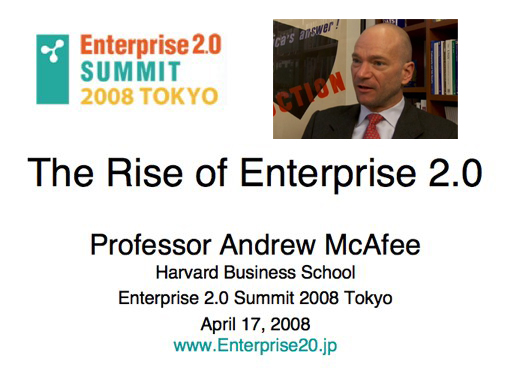
Title: The Rise of Enterprise 2.0, Andrew McAfee | Video | Enterprise 2.0 Summit 2008 Tokyo
Last month I had the pleasure of interviewing HBS Professor Andrew McAfee at the Enterprise 2.0 Summit Tokyo 2008. The forty minute interview was videotaped in Professor McAfee's HBS office based on questions submitted in advance from the Tokyo conference site (www.enterprise20.jp). Topics included the definition of Enterprise 2.0 versus Web 2.0; return on investment; risk of disclosure; factors for successful Enterprise 2.0 deployment - and a series of questions and followup on Enterprise 2.0 and competitive advantage that particularly struck me:
From Tokyo: "Do you see the benefits of Enterprise 2.0 leading to more intense and effective competition between companies? What are the common behaviors and characteristics of future winners?"
McAfee answered by reviewing three theories of Information Technology's impact on competition:
IT doesn't matter - IT brings productivity and performance benefits, but it brings them to all competitors equally.
IT has a leveling or homogenizing effect on competition ... it makes firms in an industry more similar. ... everyone's business processes should become more similar and
undifferentiated, since they're encoded in the same software. IT
doesn't separate winners from losers, in other words -- it brings them
closer together, and makes it less likely that anyone's going to stand
out.
IT does matter - its main effect is to differentiate competitors within an industry and separate winners from losers.
He said that he believes in the third theory - and that success in using Enterprise 2.0 technology is a particularly good test, since management needs to pay attention to culture, incentives, barriers to adoption, encourage bottom up participation and other issues - good management counts. The potential benefits of better communication and collaboration thoughout a business can be strategic differentiators - since the skills and capabilities of the people in the organization are rare, valuable and difficult for competitors to imitate (McAfee talked about this topic in a FastForward 07 keynote and a blog post here). Enterprise 2.0 technology becomes an enabler for Enterprise 2.0 management innovation - including lateralization of control and other practices.
In followup discussion we agreed that this seems very well aligned with Japanese management strengths in recognizing and pioneering concepts of total quality management and other management practices where collaboration is focused on:
Improving the quality of the product - from concept through design and manufacturing
Improving the competitiveness of the organization
Building and maintaining strong ties with long term suppliers and customers - as true partners
Prof McAfee said that Japanese business people may be inclined to see the competitive value in Enterprise 2.0 in reshaping how their organizations work and communicate for a shared purpose. If so, their experience in getting broadly based participation in other innovative practices may lead them to excel in Enterprise 2.0 practice as well.
I agree. This is one more reason why I interpret the "2.0" of Enterprise 2.0 as a new version of the Enterprise - rather than than the Web - supported by technology that enables new patterns of collaborative work - see Blog50: Traction Roots - Doug Engelbart